
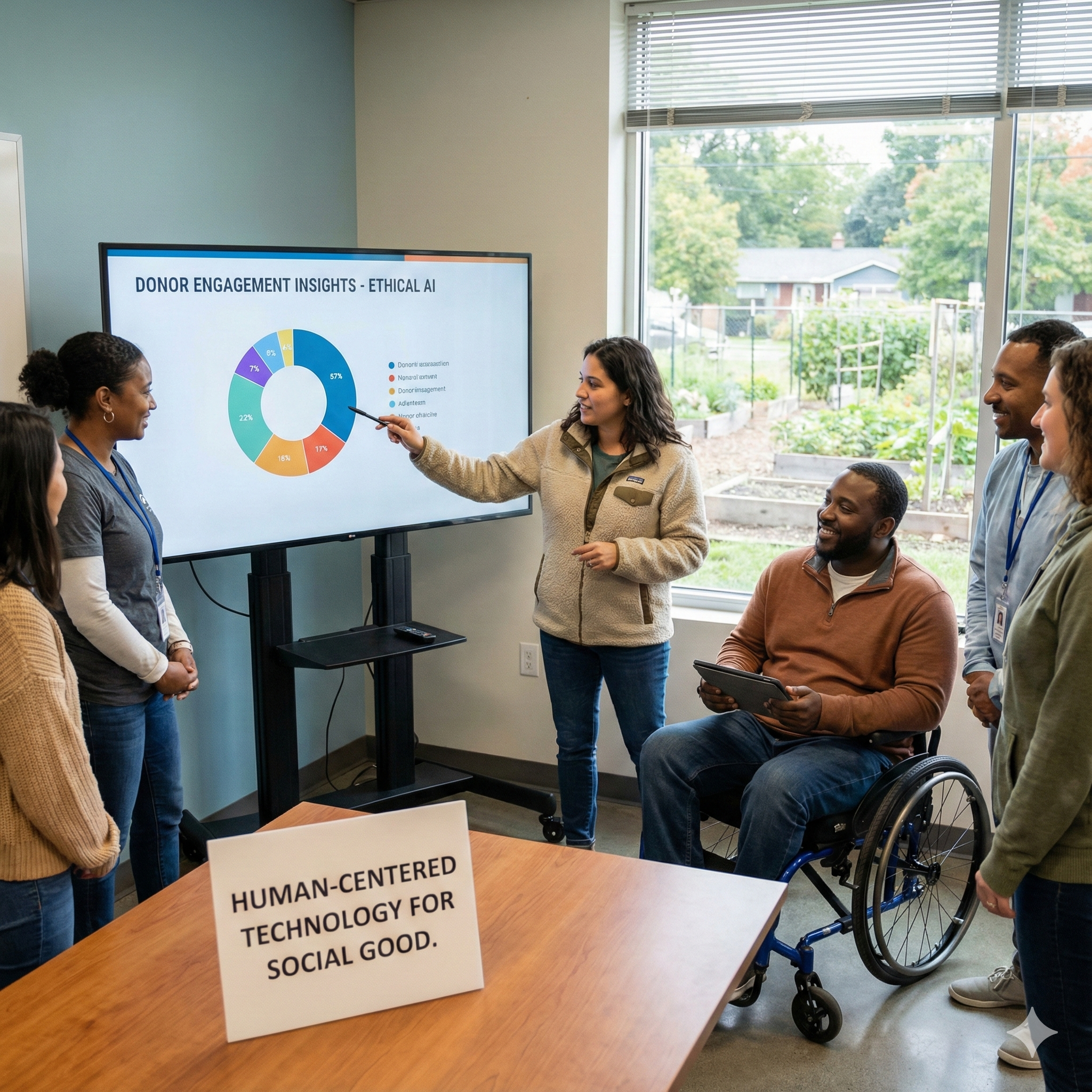
For many nonprofits, January through early spring is the quietest and most vulnerable time of year after the end-of-year activities. Yet, when approached strategically, it can be the most powerful stewardship window of the entire year.
Most of you are using AI whether you are aware of it or not and it lives much deeper than digital fundraising for nonprofits. Your constituent relationship management system (CRM or database), your email platforms, and your analytics tools all have IA capabilities integrated. During this time of year, AI can help you extract value from the work you accomplished last quarter and insert it directly into this year’s donor engagement strategy.
Where AI Adds Value to Annual Strategy:
AI for Donor Insight: Post-EOY Campaign Stewardship Intelligence
Used responsibly within the realm of your CRM, AI can be used as a stewardship lens more than a marketing tool. By gathering information about patterns of generosity and gaps in engagement, you can cultivate donors more deliberately and personally through the remainder of the year. Examples for first quarter information include:
Identifying first-time year-end donors who have multi-year potential
Flagging donors who:
Increased their gift
Gave earlier than usual
Responded to impact language rather than urgency language:
Detecting donors who gave significantly but have never been personally engaged
Using this information to build additional layers of attribution that include affinity, responsiveness, and readiness will enhance your fundraising year-round and can be especially useful in identifying individuals who are behaving like a higher-level donor but haven’t been invited to give like one. This may look like this:
Increased frequency in giving
Increased focus in designation
Engagement is rising faster than their giving
Ai for Donor Communications: Using AI to make Q1 and Q2 a Stewardship Advantage
AI for donor communications works best when it supports message alignment. You can use it to match language and content to donor values. Instead of generic messaging, when AI is utilized effectively over time, you may learn what each respective donor is responding to and you can adjust your outreach accordingly. From this information you may enhance your outreach strategies to include:
Micro-stewardship plans (90-day touchpoint maps) by donor segment
Identifying donors who should receive:
A vision conversation
A program deep dive
A site visit
A financial sustainability discussion
Use this time for precision stewardship and to earn your way to make the next major ask from sources you identify during this time.
Tips for applying it especially to 2026:
As the standard deduction has increased, fewer households receive a tax benefit from casual giving. This has quietly shifted philanthropy from transactional generosity to intentional generosity. Donors who wish to be impactful must now be more deliberate. Your AI applications can help you identify who is ready for that conversation and these are among the best practices for nonprofits using AI tools:
Donors consistently giving but under the standard deduction threshold
Donors bunching gifts every few years
Donors already using donor-advised funds or appreciated assets
AI supports this by:
- Detecting giving plateaus
- Identifying upgrade readiness
- Personalizing outreach that frames
- Multi-year commitments
- Consolidated giving
- Non-cash assets
- Endowment or sustainability conversations
AI can help you learn faster:
AI will not fix a weak strategy, but in a season where you can apply it effectively to work you’ve already accomplished, it can dramatically improve your ability to apply all four pillars of our Hyper-Philanthropy™ by enhancing your strategy, strengthening your philanthropic culture, observing stakeholder responses, and deepening your communication.
FAQ:
Q1: How can nonprofits use AI to improve donor stewardship and retention?
A: Most nonprofits are already using AI without fully realizing it—their CRM platforms, email tools, and analytics systems all have AI capabilities built in. The key is using those tools as a stewardship lens rather than just a marketing shortcut. In practical terms, AI can help your team identify first-time year-end donors who show signs of multi-year potential; flag donors who increased their gift, gave earlier than usual, or responded more strongly to impact language than urgency language; and surface donors who gave significantly but have never received a personal touch. From there, you can build micro-stewardship plans—90-day touchpoint maps by donor segment—that determine which supporters should receive a vision conversation, a program deep dive, a site visit, or a financial sustainability discussion. The result is not more outreach. It is more deliberate, better-timed outreach that earns the next major ask by building trust first. Organizations that use AI this way typically see stronger repeat giving rates and warmer referrals—not because they are communicating more, but because they are communicating with more precision and relevance.
Q2: What is the difference between generative AI and predictive AI for nonprofit fundraising?
A: These are two distinct types of AI tools that work best when used together. Predictive AI analyzes your existing data—giving history, engagement patterns, frequency, designation focus, and response to messaging—to surface insights about what donors are likely to do next. It answers questions like “Which first-time donors show multi-year potential?” Which longtime donors are quietly plateauing? Who is behaving like a major donor but has never been invited to give at that level? Generative AI, by contrast, helps you create content once you know who you are talking to. It can draft personalized stewardship messages, impact updates, and outreach language tailored to individual donor segments. The two tools work best in sequence: predictive AI tells you who deserves attention and why, and generative AI helps your team act on that insight at scale without sacrificing the personal tone that donor relationships require. Most modern nonprofit CRMs already include some form of predictive AI—the organizations getting the most value are those that have clean data, defined segments, and a team trained to act on the insights the system surfaces rather than relying on guesswork.
Q3: How does the increase in the standard deduction affect nonprofit fundraising strategy, and how can AI help?
A: As the standard deduction has increased, fewer households receive a direct tax benefit from routine charitable giving. This has quietly shifted philanthropy from transactional generosity—small gifts driven by year-end tax incentives—toward more intentional generosity, where donors who want to give meaningfully are becoming more deliberate about how, when, and in what form they give. For nonprofits, this means the donor pool is stratifying: casual givers are becoming less consistent, while mission-aligned donors who give through donor-advised funds, multi-year pledges, appreciated assets, or gift bunching are becoming more valuable and more reachable. AI tools within your CRM can help you identify exactly which donors fit each of these profiles—those consistently giving below the standard deduction threshold, those who bunch gifts every few years, and those already using non-cash assets or DAFs. With that visibility, your development team can initiate conversations about multi-year commitments, consolidated giving strategies, and endowment options at exactly the right moment, rather than waiting for donors to raise the subject themselves. The organizations best positioned in this environment are those using their data actively rather than passively.