
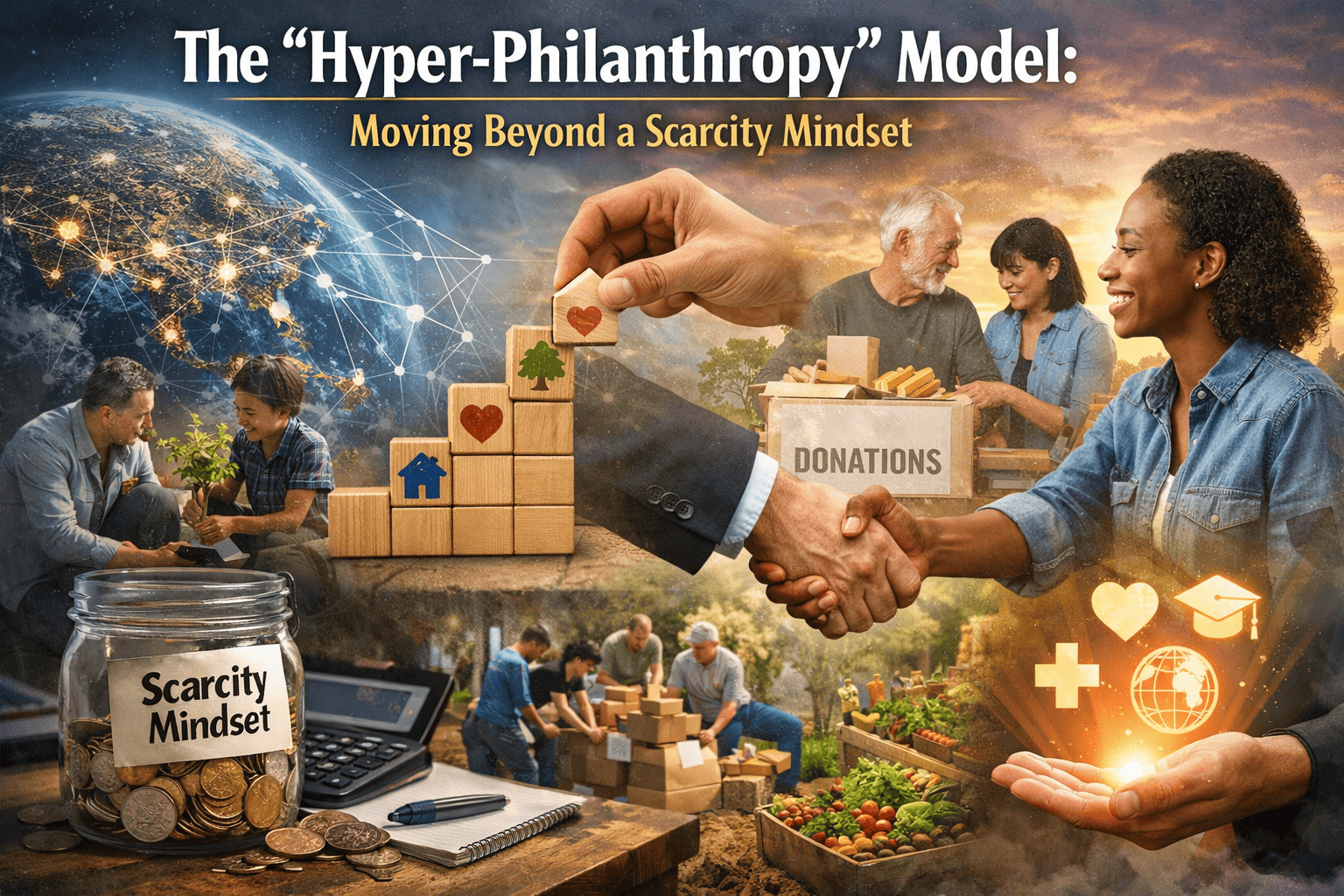
You can feel it in the day-to-day: the rushed grant deadlines, the “we can’t ask again” hesitation, the board report that focuses on what’s missing instead of what’s working. Scarcity thinking is common in nonprofit fundraising, and it’s exhausting. But it’s also optional.
The fundraising strategy consultant mindset behind Hyper-Philanthropy is simple: stop treating fundraising like a series of emergencies, and start treating it like a system that builds confidence, consistency, and momentum. That shift matters because U.S. charitable giving is large and active, but competition for attention is real.
What follows is a practical way to use the Hyper-Philanthropy model to move from “we hope we hit our number” to “we know what drives results, and we can repeat it.”
Why Scarcity Thinking Shows Up (and What It Costs):
Scarcity isn’t just “not enough money.” It’s a pattern:
Chasing any available grant instead of the right-fit opportunities
Underinvesting in staff, tools, and donor stewardship because “overhead looks bad”
Treating fundraising like a sprint, then wondering why burnout and turnover follow
A major driver is uncertainty. When your pipeline is unclear, every month feels like a cliff. And when retention is slipping, that cliff gets steeper: the Fundraising Effectiveness Project has repeatedly shown new donor retention is low, with recent reports noting that only about one in five new donors give again the following year.
Hyper-Philanthropy is built to reduce that uncertainty by making your fundraising more measurable and repeatable.
What Hyper-Philanthropy Actually Means:
Hyper-Philanthropy is defined as identifiable elements in an organization’s culture (or a community’s culture) that can be positively influenced to accelerate and maximize fundraising.
That’s important because it’s not a “bigger ask” model. It’s a “better environment for giving” model.
On The Hodge Group’s site, the model is often framed around four pillars: Strategic Vision, Culture, Behavioral Economics, and Communication.
Here’s what those pillars look like when you translate them into day-to-day fundraising decisions.
The Four Pillars in Practice: Strategic Vision: Make outcomes concrete, not abstract
If your case for support is “we help people,” you’ll attract sympathy. If it’s “we help 220 families remain housed each year, and here’s how,” you’ll attract confidence.
Practical moves:
Build a one-page “Outcomes + Proof” sheet: 3 outcomes, 3 metrics, 3 proof points (testimonials, program data, partner validation).
Align your grant calendar to what you can actually deliver and measure (not just what sounds fundable).
Culture: Clarify roles so fundraising isn’t lonely:
Scarcity grows when fundraising is “the development person’s job.” Hyper-Philanthropy spreads ownership without spreading chaos.
For boards and committees, role clarity can be as simple as:
Quarterly targets (dollars, meetings, stewardship touches)
A short list of “acceptable actions” (intro emails, event hosting, thank-you calls)
A shared definition of what success looks like this quarter
Behavioral Economics: Reduce friction for donors:
People give when it feels easy, meaningful, and safe.
Example: If you accept stock or offer multi-year pledge options for a major initiative, you reduce the “all at once” barrier that stops many donors. This approach shows up in Hyper-Philanthropy writing as a way to meet donors where they are.
Communication: Build a cadence, not a campaign:
A scarcity mindset often over-relies on big moments (giving days, year-end). Hyper-Philanthropy favors consistent signals of impact.
A simple cadence that works:
Monthly: one impact story tied to one metric
Quarterly: one board-facing dashboard (pipeline, wins, risks, next actions)
Ongoing: thank-you touches that are fast, specific, and human
A 30–60 Day “Anti-Scarcity” Reset Your Team Can Actually Run:
Step 1: Install a fit score for grants and funding opportunities
Grant managers and program leaders can stop wasting cycles by scoring opportunities on 5 criteria:
Mission alignment
Eligibility certainty
Capacity to deliver + measure outcomes
Budget match (real costs included)
Reporting burden vs. payoff
This helps you say “no” faster, and “yes” with confidence.
Step 2: Run win–loss reviews (not blame sessions)
Once per quarter, review:
3 wins: what made them winnable?
3 losses: what was missing (fit, story, outcomes, relationships, timing)?
Then update your boilerplates and templates so you get faster and sharper each cycle.
Step 3: Budget for performance, not optics
The Overhead Myth campaign (led by major nonprofit evaluators) warned against using overhead ratios as the primary way to judge a nonprofit’s value, emphasizing performance over low administrative costs.
Translation: investing in systems, data, and stewardship is not “extra.” It’s how you stop living grant to grant.
Step 4: Treat retention like a program, not an afterthought
If donor retention is sliding across the sector, your edge is simply being more intentional than average.
Start with a “first 90 days” plan for new donors: welcome, proof of impact, and one clear next step.
Where Outside Expertise Fits (Without Turning Your Work Into a Pitch):
Not every team needs outside help. But many benefit from a neutral, structured partner who can install the system, train the team, and create reusable assets.
That’s where fundraising consulting services can be useful, especially when you need a working grant calendar, fit scoring, board reporting, and a repeatable pipeline across programs. As you evaluate options across philanthropy consulting firms, look for process clarity, measurable outputs, and real experience with both grants and donor development.
FAQs: Hyper-Philanthropy and Scarcity Mindset Shifts:
Q1. How can a nonprofit break out of a scarcity mindset and build a more sustainable fundraising system?
Scarcity thinking in nonprofit fundraising is not a character flaw—it is usually a structural problem. When your pipeline is unclear, when retention is slipping, and when grant deadlines are treated as emergencies rather than planned milestones, every month feels like a cliff. The way out is not inspiration—it is system design. At The Hodge Group, we use a framework called Hyper-Philanthropy, which treats fundraising as a set of identifiable, repeatable behaviors that can be built into an organization’s culture rather than chased campaign by campaign. In practical terms, breaking the scarcity cycle starts with four moves: installing a fit score for grants and funding opportunities so your team stops pursuing the bottom half of the pipeline; running quarterly win-loss reviews to get faster and sharper with each cycle; budgeting for performance rather than optics so that investments in staff, data, and stewardship are treated as strategy rather than waste; and building a “first 90 days” retention plan for new donors so you are not constantly replacing the base you already spent resources to build. None of these require a larger team. They require a clearer system and a leadership team willing to stop treating fundraising like a series of emergencies
Q2. What is a sustainable nonprofit fundraising strategy, and how do you build one?
A sustainable nonprofit fundraising strategy is one that produces consistent, repeatable results without depending on heroic individual efforts, lucky timing, or a single major grant that everything else is built around. It is built on four interconnected pillars. Strategic vision means your outcomes are concrete and measurable—not “we help people,” but specific impact statements tied to real numbers and credible proof points that donors and funders can evaluate. Culture means fundraising ownership is shared across the organization, with board members, staff, and volunteers operating from role clarity rather than vague expectations. Behavioral economics means your donor experience is designed to make giving easy, clear, and identity-affirming—reducing friction at every step from the first ask to the annual renewal. And communication means you are sending consistent impact signals throughout the year, not just during year-end or giving day campaigns. Together these four pillars shift an organization from chasing revenue to building an environment where generosity grows naturally. The most practical starting point for most organizations is the communication pillar: a monthly impact story, a quarterly board dashboard, and a steady stewardship cadence do more to stabilize fundraising than any single campaign tactic.
Q3. How can boards support Hyper-Philanthropy without feeling like salespeople?
Give them specific, low-pressure actions: introductions, thank-you calls, hosting small gatherings, and sharing impact stories tied to outcomes.
Q4. What’s one change we can make this month that creates momentum?
Run a grant “fit score” on your next 10 opportunities and stop pursuing the bottom half. The time you save becomes capacity for better applications and stronger donor stewardship.
Final Thoughts:
Hyper-Philanthropy is a mindset shift, but it only becomes real when it turns into routines: clearer outcomes, smarter grant choices, steadier communication, and shared ownership. When you build the system, scarcity stops running the show, and fundraising becomes something your team can repeat with confidence.